Zombie alert: COBOL died in 1960
Around 1960, a frustrated committee member had a tombstone engraved with "COBOL" and shipped it, collect, to the Pentagon. Sixty-six years later the corpse is still processing your paycheck.
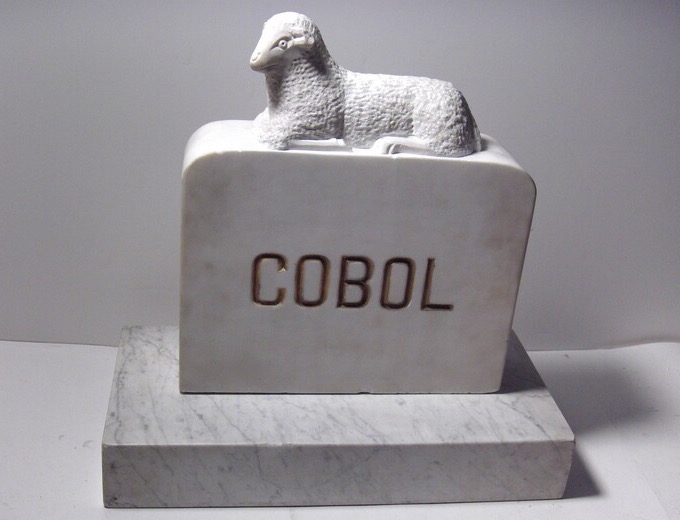
The COBOL tombstone, complete with sacrificial lamb. Photo: Computer History Museum.
Happy Halloween. Lock the doors, check under the bed, and whatever you do, don't look directly at the mainframe.
Every good horror story starts with a death certificate, and COBOL has an unusually solid one: 82 pounds of marble with the name in gold leaf. It sits in the Computer History Museum in California. The language it buried is, as I write this, still running a frightening share of the world's banks, insurers and government agencies.
Nobody seems to have told COBOL that it's dead, so let's go through the paperwork.
The birth (1959)
In the spring of 1959, a group led by Mary Hawes of Burroughs went to the US Department of Defense with an idea: one common business language for every computer, instead of a new one for every manufacturer. The DoD was running 225 computers and had 175 more on order, so Charles A. Phillips, director of the Pentagon's Data Systems Research Staff, didn't need much convincing. On 28–29 May 1959 he chaired the first meeting of what became CODASYL, the Conference on Data Systems Languages.
CODASYL then did what committees do: it made more committees. A short-range committee would quickly put together a stopgap language, and an intermediate-range committee would later build the proper one. Remember that word, stopgap. It comes back later, probably at night.
The short-range committee had people from six computer manufacturers and three government agencies, and it was, predictably, far too big to move fast. One of its members was Howard Bromberg, RCA's representative and the manager of RCA's Automatic Programming Group.
The murder (1960)
Bromberg had a problem. RCA was building its COBOL compiler while the committee was still designing the language, trying to stay about a week behind the specification. In his own words: "When we moved a week ahead of the committee, I got nervous."
So one Friday afternoon, around three o'clock, he called Charlie Phillips, described his feelings about the pace of the work "in colorful language", suggested Phillips do something about it, hung up, and left the office "in a fit of pique".
On the drive home he spotted a monument company next to a freeway exit. Easy off, easy on. He took the easy off and asked for a compact monument that "would show my appropriate respect", since he would have to ship it. He picked one with a lamb on top, because he "liked the sacrificed lamb effect". When the clerk asked what name to engrave, he wrote down COBOL.
"What kind of name is that?"
"Well, it's a Polish name. We shortened it and got rid of a lot of unnecessary notation."
(If you've ever written ADD 1 TO WS-COUNTER GIVING WS-COUNTER, you'll appreciate the bit about unnecessary notation.)
Two weeks later the stone was ready, with the name gold-leafed. Bromberg took it home rather than to the office, which he later called "probably the smartest thing that I've ever done". His neighbors helped him build a crate for it on the sidewalk, mostly because they wanted the thing out of the neighborhood. Then he shipped it to Charlie Phillips at the Pentagon. Collect. Yes: the Department of Defense paid the shipping on COBOL's tombstone.
Two weeks went by without a word. Bromberg called Phillips, chatted about the weather, and finally asked whether he had received anything in the mail.
"I did indeed. I wonder what you meant by that?"
"Thank you, Charlie." Click.
Soon after, Bromberg was summoned to RCA's vice-presidential suite. Headquarters at Rockefeller Center had heard that he had sent a tombstone to the Department of Defense, and worried that this might not help RCA win defense contracts. Had he done that? Yes. Would he like to explain why? No. "Thank you." Nobody ever mentioned it again.
The cover-up
For twenty-five years Bromberg denied everything. "What tombstone?" The stone turned up as a drawing on the cover of Communications of the ACM, Grace Hopper told the story wherever she went, the phone kept ringing, and Bromberg kept knowing nothing about it.
He finally confessed on 16 May 1985, at COBOL's 25th anniversary celebration at The Computer Museum in Boston, standing next to the tombstone itself. Phillips had kept it, and it was later given to the museum. Bromberg hadn't seen it in twenty-five years and was, he said, "still very pleased".
A side note: Grace Hopper
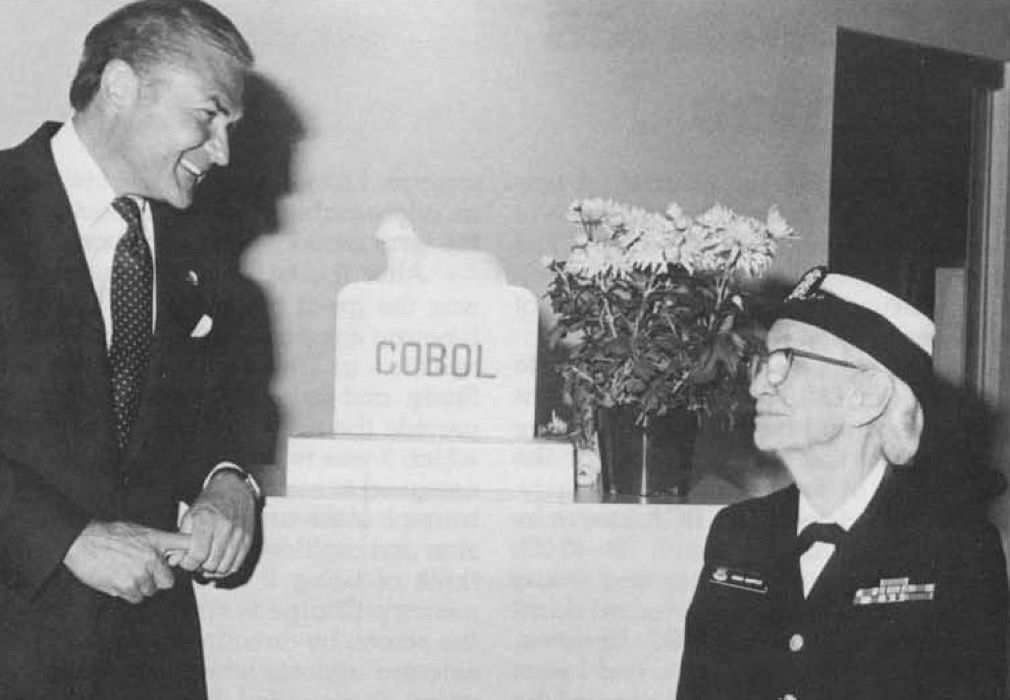
The woman next to the tombstone in this photo, with the culprit himself on the left, is Commodore (soon to be Rear Admiral) Grace Hopper, and she is the reason COBOL reads like English at all. Her earlier language, FLOW-MATIC, wrote programs as English statements at a time when she was told this was impossible, because "computers don't understand words". Her answer, at that same 1985 celebration: they don't have to, they just have to compare bit patterns.
FLOW-MATIC was one of the main models for COBOL, and Hopper's staff sat on the committee. That's why she is often called the mother, or grandmother, of COBOL. Jean Sammet, one of the six people who actually wrote the specification, objected to that title: Hopper's influence was real but indirect, through her people. Either way, nobody disputes who pushed English-like programming into the mainstream.
Hopper also has impeccable Halloween credentials. In 1947, the team running the Harvard Mark II, which she worked on, found a moth stuck in a relay, taped it into the log book as the "first actual case of bug being found", and gave the world its favorite word for things that crawl out of software. She retired from the Navy in 1986 at 79, the oldest serving officer, and left us the motto that every engineer lives by: it's much easier to apologize than to get permission.
The undead (1960–forever)
The first COBOL specification was published in 1960. Since then:
- In 2017, Reuters estimated that around 220 billion lines of COBOL were still in use, behind 43% of banking systems and 95% of ATM card swipes.
- In April 2020, as pandemic unemployment claims flooded in, the governor of New Jersey publicly asked for volunteers with "cobalt" skills to keep the state's 40-year-old mainframes running. He meant COBOL. The language is so dead that people can't even remember its name, and yet they still need it.
- The latest ISO standard for COBOL is from 2023. The corpse still gets software updates.
Not bad for a temporary, short-range stopgap. The proper, long-term language it was supposed to make way for never showed up.
So this Halloween, if you hear something shuffling around the server room at night, don't panic. It's only COBOL. It died in 1960; there's a tombstone to prove it. It just hasn't noticed.
Bromberg said the tombstone showed "the ability to make fun of oneself personally and professionally". COBOL has clearly taken the joke in good spirit. It has outlived its own funeral, its undertaker and most of its mourners.
Sources: "The Story of the COBOL Tombstone", The Computer Museum Report vol. 13 (Summer 1985), a transcript of the 25th-anniversary celebration; the Computer History Museum catalog (object X572.85); Wikipedia, "COBOL"; Reuters (2017); The Register and CNBC (April 2020).
Photos: the COBOL tombstone © Computer History Museum (catalog X572.85). Howard Bromberg and Grace Hopper at The Computer Museum, 16 May 1985, photo by Lilian Kemp, from The Computer Museum Report vol. 13.